
Property Investment Guide
Property Holding Costs in Malaysia: What Buyers Often Forget
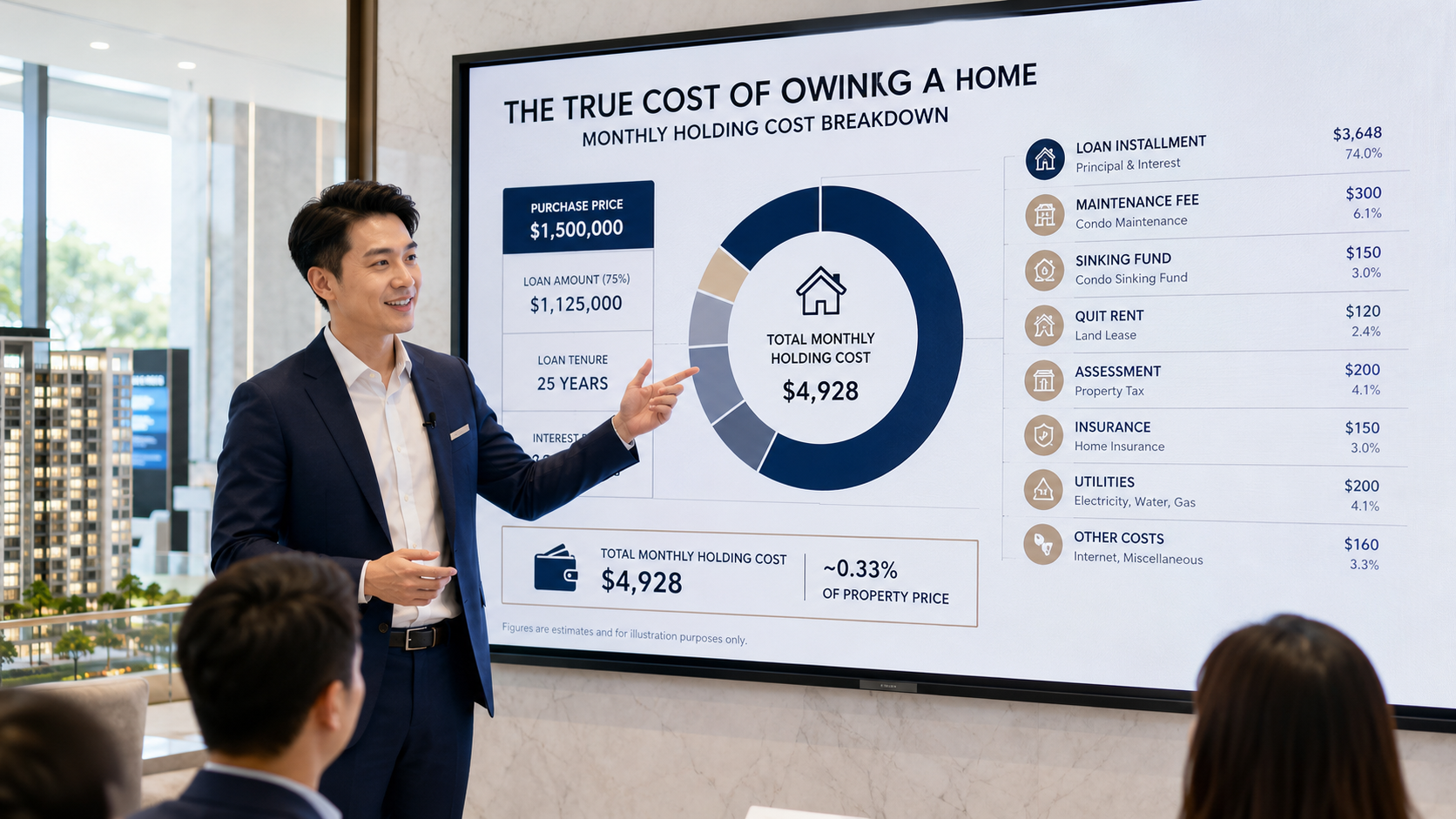
The purchase price is only the entry point of property ownership. After the booking fee, down payment and legal process, buyers still need to manage monthly, annual and irregular expenses throughout the holding period. These costs can affect affordability, rental return and the ability to continue owning the property during weaker financial periods. This guide explains the property holding costs Malaysian buyers and investors should estimate before committing to a purchase.


Quick Answer
Property holding costs in Malaysia normally include the housing-loan payment, progressive interest for under-construction properties, maintenance charges, sinking-fund contributions, assessment tax, quit rent or parcel rent, insurance, utilities, repairs and replacement costs. Investors should also budget for vacancy, property-agent fees, property management, tenant turnover and income-tax obligations. A safe comparison uses the complete monthly and annual ownership cost—not only the advertised instalment or gross rental yield.
Many property presentations focus on:
- The net purchase price
- The estimated monthly loan instalment
- The promotional discount
- The expected rental income
- The projected rental yield
These figures may be useful, but they do not show the complete cost of ownership.
Some expenses are paid every month. Others appear once or twice a year. Major repairs and replacement expenses may only arise after several years, but they can still materially affect the owner’s return and cash flow.
Do not decide that a property is affordable based only on the booking fee, down payment or advertised monthly instalment. The relevant question is whether the buyer can manage the complete ownership cost throughout the intended holding period.
1. Separate Purchase Costs From Holding Costs
Property costs can be divided into three broad groups.
Purchase and entry costs
These may include:
- Booking or earnest deposit
- Down payment
- Sale and Purchase Agreement legal costs
- Loan-agreement costs
- Stamp duties
- Valuation fee
- Foreign-buyer consent costs where applicable
- Initial furnishing and renovation
- Initial utility deposits
Holding costs
These continue while the buyer owns the property:
- Loan instalment
- Progressive interest or profit
- Maintenance fee
- Sinking fund
- Assessment tax
- Quit rent or parcel rent
- Insurance
- Utilities
- Routine repairs
- Property-management costs
- Vacancy and tenant-turnover costs
Exit costs
These arise when selling:
- Estate-agency fee
- Legal costs
- Loan settlement or discharge costs
- Repair or presentation cost before sale
- Real Property Gains Tax where applicable
- Outstanding management or authority payments
This article focuses mainly on the second group: the cost of continuing to own the property.
Create separate budgets for acquisition, ownership and exit. A purchase package that reduces entry costs does not necessarily make the property inexpensive to hold.
2. Monthly Housing-Loan Instalment
For most financed buyers, the loan instalment is the largest recurring cost.
The actual payment depends on:
- Purchase price
- Financing amount
- Financing margin
- Loan tenure
- Interest or profit rate
- Financing structure
- Bank terms
- Changes allowed under the financing agreement
Buyers should not assume that today’s instalment will remain unchanged for the entire financing period.
Where the financing payment can change according to the bank’s reference rate or other contractual terms, owners should test whether they could still afford the property under a higher-payment scenario.
Example stress test
If the expected monthly instalment is RM3,000, do not test the budget only at RM3,000.
Also test:
- RM3,300
- RM3,600
- A temporary period with no rental income
- An unexpected repair during the same month
The purpose is not to predict the exact future payment. It is to determine whether the buyer has enough financial flexibility.
Louis Property Insights View
A property is not comfortably affordable merely because the bank approves the loan.
Bank approval determines whether financing may be offered. It does not decide whether the remaining monthly cash flow is healthy for the buyer’s lifestyle, family commitments and emergency needs.
3. Progressive Interest During Construction
For an under-construction property, the bank normally releases financing according to the project’s construction progress and the financing agreement.
Before the full loan is disbursed, the buyer may pay interest or profit on the amount already released.
This is commonly referred to as progressive interest.
The amount generally increases as more construction stages are completed.
Buyers should therefore prepare for a pattern such as:
- Lower payments during early construction
- Increasing payments as more financing is released
- Full instalment after full disbursement or completion, according to the facility terms
Progressive interest is especially important when the buyer is also paying:
- Existing rent
- Another housing loan
- Education or family expenses
- Renovation deposits
- Additional cash caused by a lower financing margin

Ask the bank or financing adviser for an illustration of possible progressive payments. Treat it as an estimate and maintain a cash buffer for differences in construction timing and disbursement.
4. Maintenance Charges
Strata-property owners normally contribute to the upkeep and management of common property.
Maintenance charges may support expenses such as:
- Security
- Cleaning
- Lift servicing
- Common-area electricity
- Landscaping
- Swimming-pool maintenance
- Building-management staff
- Access-control systems
- Common-area repairs
- Waste-management arrangements
- Insurance or professional services managed by the building
The amount may depend on the project’s approved share units, management budget and applicable management arrangements.
Do not compare projects using only the quoted rate per square foot.
Also compare:
- Total monthly amount for the selected unit
- Number of facilities
- Number of lifts
- Size of common property
- Total number of units sharing the expenses
- Whether the rate is estimated or already billed
- Whether car parks or accessory parcels affect charges
- Whether the budget appears realistic for the building
A very low estimated maintenance fee may later prove insufficient if the development has extensive facilities, complex mechanical systems or high operating requirements.
Estimated maintenance fees in a sales presentation can change. Check whether the figure is contractual, estimated, currently billed or subject to the future management budget.
5. Sinking-Fund Contribution
The sinking fund is separate from the ordinary maintenance account.
It is intended for longer-term capital expenditure involving common property, which may include major replacement, renewal or upgrading work.
Examples may include:
- Lift replacement or major overhaul
- External repainting
- Roof or waterproofing work
- Replacement of pumps
- Major mechanical and electrical systems
- Common-area refurbishment
- Significant structural or facility work
Under the relevant Strata Management Regulations, the sinking-fund contribution for specified management stages is set at a sum equivalent to 10% of the Charges.
Buyers should still confirm the actual amount billed for the project and whether additional contributions or special levies may arise.
| Strata Cost Check | What to Verify |
|---|---|
| Maintenance charge | Current or estimated monthly amount for the exact unit |
| Sinking fund | Current billed amount and calculation method |
| Share units | How the unit’s contribution is allocated |
| Special levy | Whether any approved or proposed additional collection exists |
| Arrears | Whether the selected completed unit has outstanding management payments |
| Management stage | Developer, JMB or MC management |
Louis Property Insights View
A well-managed building needs enough money to operate and maintain its common property.
The lowest fee is not automatically the best fee. Buyers should consider whether the budget is realistic, whether collection is healthy and whether the building is being maintained properly.
6. Assessment Tax
Assessment tax, commonly called cukai taksiran, is charged by the relevant local authority.
For a Kuala Lumpur property, the responsible authority may be Dewan Bandaraya Kuala Lumpur, depending on the property’s location.
The amount is not determined by the property’s purchase price alone. It is based on the local authority’s valuation and applicable assessment framework.
Buyers should check:
- The correct local authority
- The latest assessment bill
- Payment schedule
- Outstanding amounts
- Whether the owner’s name and correspondence details are updated
- How to access online checking or payment
For budgeting, convert the annual or term-based bill into a monthly equivalent.
Annual or total scheduled assessment cost ÷ 12 = monthly budgeting allowance
This does not change the actual payment schedule. It simply prevents the expense from being forgotten.
7. Quit Rent or Parcel Rent
Land-related tax may be described as quit rent, cukai tanah or parcel tax, depending on the title, state and current land-administration arrangement.
For strata property, owners should confirm whether an individual parcel-tax account has been issued or whether the relevant payment is still handled through another arrangement.
Check:
- The relevant land office
- Title status
- Individual or strata account information
- Latest bill
- Arrears
- Payment deadline
- Whether the property records need updating
The amount and administration differ by state and title type, so buyers should not copy a figure from another property.
Before buying a completed or subsale unit, request the latest assessment and land or parcel-tax bills together with proof of payment. Outstanding amounts should be resolved clearly during the legal process.
8. Building, Fire, Contents and Related Insurance
Insurance needs vary according to property type, financing and what is already covered by a building or master policy.
Owners should check:
- What the building policy covers
- Whether renovations are covered
- Whether contents are covered
- Whether personal liability is covered
- Whether loss of rent is covered
- Whether additional fire or homeowner protection is required
- Whether the bank requires specific coverage
- Whether mortgage-reducing or mortgage-level protection was selected
Do not assume that a building’s master policy covers:
- Furniture
- Personal belongings
- Renovation
- Appliances
- Tenant-caused damage
- Temporary accommodation
- Rental loss
- Every form of water damage
Read the policy documents and obtain professional advice for the actual property and intended use.
9. Utilities, Internet and Service Costs
For own stay, owners may need to budget for:
- Electricity
- Water
- Sewerage-related charges
- Internet
- Television or subscription services
- Access cards
- Parking access
- Additional parking rental
- Air-conditioning servicing
- Water filters
- Pest control
- Cleaning
- Waste or service charges not included in management fees
For investment, determine which items will be:
- Paid by the tenant
- Included in the rent
- Retained under the owner’s account
- Paid during vacancy
- Required for short- or medium-term rental operations
A vacant unit can still generate utility, service and minimum-account costs.
10. Furnishing and Renovation Are Not One-Time Costs
The first furnishing budget is only the beginning.
Items eventually require repair or replacement.
Examples include:
- Air conditioners
- Refrigerator
- Washing machine
- Water heater
- Mattress
- Sofa
- Curtains
- Lighting
- Built-in cabinets
- Locks
- Digital access devices
- Paint
- Plumbing fittings
- Electrical fittings
- Kitchen appliances
Investors should distinguish between:
Initial furnishing cost
The cost required to prepare the unit for first occupation or first tenancy.
Replacement reserve
Money kept aside for future repair and replacement.
A furnished rental unit may achieve a higher rent, but it also creates more items for the owner to maintain.
| Replacement Item | Expected Planning Approach |
|---|---|
| Air-conditioning | Allow for servicing, repair and eventual replacement |
| Appliances | Keep invoices, warranties and replacement reserve |
| Furniture | Choose durable items suitable for the target tenant |
| Paint and minor defects | Budget between tenancies |
| Locks and access devices | Allow for replacement or resetting |
| Curtains and soft furnishings | Plan for cleaning and wear |

11. Routine Repairs and Unexpected Repairs
Every property requires maintenance.
Routine expenses may include:
- Air-conditioning service
- Plumbing repair
- Electrical repair
- Door and lock adjustment
- Appliance repair
- Sealant replacement
- Minor water leakage
- Paint touch-up
- Pest treatment
- Cleaning
Larger unexpected expenses may include:
- Major water damage
- Built-in cabinet repair
- Appliance replacement
- Electrical-system problems within the parcel
- Flooring repair
- Damage after a tenancy
- Renovation required to remain competitive in the rental market
A new property is not automatically maintenance-free.
The Defect Liability Period may cover qualifying defects according to the contract, but it does not remove every ownership, maintenance or damage expense.
Do not spend the entire available cash amount on the down payment and furnishing. A property owner without an emergency reserve may be forced to use expensive short-term borrowing when repairs arise.
12. Vacancy Cost for Investment Property
Gross rental-yield calculations often assume that the unit is occupied every month.
Real ownership may include:
- Time required to find the first tenant
- Vacancy between tenancies
- Time needed for repairs
- Cleaning
- Advertising
- Viewings
- Tenancy negotiation
- Delayed rent
- Tenant default
- Periods when the unit cannot be occupied
During vacancy, the owner may still pay:
- Loan instalment
- Maintenance fee
- Sinking fund
- Assessment tax
- Land or parcel tax
- Insurance
- Minimum utilities
- Internet, if retained
- Repairs
- Agent or advertising costs
Calculate rental performance using at least three scenarios:
– Conservative: lower rent and longer vacancy – Base: realistic rent and normal vacancy – Strong: higher rent and shorter vacancy
The property should remain manageable under the Conservative scenario.
13. Property-Agent and Tenant-Turnover Costs
An investor may incur costs when obtaining or renewing a tenancy.
These can include:
- Estate-agency fee
- Advertising
- Tenancy-agreement preparation
- Stamp duty
- Inventory preparation
- Cleaning
- Minor repair
- Key or access-card replacement
- Utility-account administration
- Property inspection
- Renewal handling
Do not divide the agent’s fee only by the first month of the tenancy.
For comparison purposes, spread expected turnover costs across the likely tenancy period.
Expected tenant-turnover cost ÷ expected tenancy months = monthly equivalent
This creates a more realistic net-rental calculation.
14. Property-Management Cost
Some owners manage tenants directly.
Others appoint a property manager or rental operator.
Possible services include:
- Marketing
- Tenant screening
- Check-in and check-out
- Rent collection
- Inspection
- Maintenance coordination
- Housekeeping
- Linen or consumable management
- Short-term rental operations
- Monthly reporting
Compare:
- Fixed monthly fee
- Percentage of rent
- Leasing fee
- Renewal fee
- Maintenance mark-up
- Emergency call-out fee
- Cleaning fee
- Platform fee
- Cancellation or contract terms
A high gross rent can become a weak net return after management, platform and operating expenses.
15. Rental Income and Tax Record-Keeping
Rental income may be taxable in Malaysia.
The Inland Revenue Board’s public ruling on income from letting real property explains the treatment of rental income and examples of allowable direct expenses.
Depending on the circumstances and applicable tax rules, expenses connected with producing rental income may include items such as:
- Assessment tax
- Quit rent
- Interest on qualifying financing
- Fire-insurance premium
- Rent-collection expenses
- Tenancy-renewal expenses
- Ordinary repairs that maintain the property’s existing condition
Not every expense is automatically deductible.
Initial expenses used to create the first rental source, capital improvements and private expenses may receive different treatment.
Owners should retain:
- Tenancy agreements
- Rental statements
- Bank records
- Assessment and land-tax bills
- Insurance documents
- Financing statements
- Agent invoices
- Repair invoices
- Management statements
- Utility records where relevant
This article is not tax advice. Tax treatment depends on the owner, nature of the rental activity, timing and actual expenses. Confirm the current position with LHDN guidance or a qualified tax professional.
16. Special Levies and Changes in Strata Costs
Maintenance and sinking-fund contributions may not cover every major expense.
A management body may need additional funding for significant work, subject to the applicable process and approvals.
Possible examples include:
- Major lift work
- Façade repair
- Waterproofing
- Structural work
- Replacement of ageing systems
- Major security-system upgrade
- Court or professional costs
- Urgent common-property work
For completed strata property, review:
- AGM and EGM minutes
- Audited accounts
- Maintenance collection rate
- Sinking-fund balance
- Existing arrears
- Approved special levies
- Major planned work
- Insurance claims
- Ongoing disputes
These records can reveal costs that are not visible from the unit itself.
17. Own-Stay and Investment Holding Costs Are Different
Own-stay property
The owner should focus on:
- Total monthly affordability
- Utilities
- Maintenance
- Insurance
- Repairs
- Renovation replacement
- Family cash buffer
- Ability to hold through income disruption
Investment property
The owner should additionally include:
- Vacancy
- Agent fee
- Property management
- Tenant turnover
- Furnishing replacement
- Rental income tax
- Advertising
- Cleaning
- Delayed rent
- Tenant damage
- Higher operating requirements
A property that is comfortable for own stay may not produce an attractive net investment return.
A property with a reasonable investment yield may not be suitable for the owner’s lifestyle.
18. Build a Monthly Holding-Cost Estimate
Use a monthly equivalent even for expenses paid annually or irregularly.
| Holding Cost | Monthly Estimate |
|---|---|
| Loan instalment | Enter amount |
| Progressive interest, if applicable | Enter estimate |
| Maintenance fee | Enter amount |
| Sinking fund | Enter amount |
| Assessment tax monthly equivalent | Enter amount |
| Quit rent or parcel rent monthly equivalent | Enter amount |
| Insurance monthly equivalent | Enter amount |
| Utilities retained by owner | Enter amount |
| Repair and replacement reserve | Enter amount |
| Agent and turnover reserve | Enter amount |
| Property-management fee | Enter amount |
| Vacancy reserve | Enter amount |
| Other recurring expenses | Enter amount |
| Total Monthly Holding Cost | Add all items |
| Expected rent, if applicable | Enter conservative rent |
| Estimated Monthly Cash Flow | Rent minus total holding cost |
This is a planning estimate, not a guarantee.
The figures should be updated when:
- Financing terms change
- The project reaches completion
- Actual management charges are issued
- Assessment or parcel-tax bills change
- The tenant changes
- Insurance renews
- Major repairs occur
- Market rent changes
19. Maintain a Property Cash Buffer
There is no single cash-buffer amount suitable for every buyer.
The required reserve depends on:
- Number of properties owned
- Stability of income
- Loan size
- Rental dependence
- Property age
- Furnishing level
- Family commitments
- Insurance coverage
- Ease of selling the property
- Availability of other savings
A more conservative owner may hold several months of full property expenses rather than only several months of instalments.
The reserve should consider:
- Loan payment
- Maintenance and sinking fund
- Taxes
- Insurance
- Utilities
- Repair
- Vacancy
- Tenant turnover
Louis Property Insights View
The purpose of a cash buffer is not to maximise idle money.
It is to prevent a temporary vacancy, repair or income disruption from turning a manageable property into a forced sale or expensive debt problem.

A Practical Holding-Cost Checklist
| Question | Status | Notes |
|---|---|---|
| Have I calculated the complete monthly cost? | ☐ | Enter notes |
| Have I included progressive interest? | ☐ | Enter notes |
| Is the maintenance fee confirmed or estimated? | ☐ | Enter notes |
| Have I included the sinking fund? | ☐ | Enter notes |
| Have I checked assessment tax? | ☐ | Enter notes |
| Have I checked quit rent or parcel rent? | ☐ | Enter notes |
| Do I understand the insurance coverage? | ☐ | Enter notes |
| Have I included a repair reserve? | ☐ | Enter notes |
| Have I allowed for appliance replacement? | ☐ | Enter notes |
| Have I included vacancy? | ☐ | Enter notes |
| Have I included agent and management costs? | ☐ | Enter notes |
| Have I considered rental tax records? | ☐ | Enter notes |
| Can I hold the property under a weaker scenario? | ☐ | Enter notes |
| Do I have a separate emergency reserve? | ☐ | Enter notes |
Louis Property Insights Verdict
Louis Property Insights View
The true cost of a property is not the purchase price alone.
A suitable purchase should remain manageable after adding financing, progressive interest, maintenance, sinking fund, taxes, insurance, utilities, repairs and the costs associated with vacancy or tenant turnover.
For investors, the most useful figure is not gross rental yield. It is the realistic net cash flow after ownership and operating expenses.
For own-stay buyers, the most important question is whether the property leaves enough room for normal life, savings and emergencies after every recurring cost is paid.
Before committing, calculate the property under a conservative scenario and decide whether you can continue holding it without depending on perfect conditions.
Frequently Asked Questions
What are the main property holding costs in Malaysia?
Common holding costs include the loan instalment, progressive interest for an under-construction property, maintenance fee, sinking fund, assessment tax, quit rent or parcel rent, insurance, utilities, repairs and replacement costs.
Is the sinking fund included in the maintenance fee?
It is normally shown as a separate contribution. Under the relevant Strata Management Regulations, the contribution for specified management stages is set at a sum equivalent to 10% of the Charges. Confirm the actual billing for the project.
Is maintenance fee calculated only by square foot?
Not necessarily. Strata charges may be allocated using approved share units and the scheme’s management arrangements. Confirm the amount for the exact parcel and accessory parcels.
What is the difference between assessment tax and quit rent?
Assessment tax is charged by the relevant local authority. Quit rent or parcel tax is administered through the relevant land authority. The amount and billing method depend on the property, title and location.
Do I still pay holding costs when the property is vacant?
Yes. Loan payments, maintenance, sinking fund, taxes, insurance and some utility or management costs may continue even when no rent is received.
Is gross rental yield enough to judge an investment?
No. Gross yield does not include financing, maintenance, sinking fund, taxes, insurance, repairs, vacancy, agent fees, management costs and tax considerations.
Can rental-property expenses be claimed for income-tax purposes?
Certain direct expenses may be deductible under applicable tax rules, but not every expense qualifies. Refer to current LHDN guidance and obtain professional advice for the actual situation.
How much cash buffer should a property owner keep?
There is no universal amount. The reserve should reflect the full monthly ownership cost, income stability, vacancy risk, property condition and likely repair expenses.
Can maintenance fees increase after completion?
Management budgets and actual operating requirements may change. Buyers should treat estimated charges as time-sensitive and review current notices, budgets and management records.
Should I include renovation in holding cost?
Initial renovation is generally an entry cost, but repair, refurbishment and future replacement should be included in long-term ownership planning.
Official Sources and Verification
- KPKT Strata Management Regulations
- KPKT Strata Management Handbook 2.0
- DBKL Assessment Tax
- PTG Wilayah Persekutuan Land and Parcel Tax Payment
- LHDN Public Ruling No. 12/2018: Income From Letting of Real Property

Need Help Calculating the Real Cost of a Property?
Share the project, unit price, expected financing and intended use with Louis Property Insights. The property can be reviewed from a buyer-focused perspective, including ownership cost, layout, location, investment considerations and key risks.
Disclaimer: This article provides general property-buying information and does not constitute legal, financial or loan advice. Laws and contractual arrangements may differ according to the property type, location and transaction. Buyers should obtain advice from qualified professionals based on the actual documents involved.